
Free GitHub
Security Audit
Instantly scan any GitHub repository with Trivy, Gitleaks, Semgrep, npm audit, Snyk, Socket, Terrascan, license-checker, and optional live-site security headers. Detects CVEs, secrets, SAST issues, supply-chain risks, IaC misconfigurations, and license problems.
Free preview on this site — join PTM for AI remediation, unlimited scans, and full workspace history.
Scan Repository
Public or private (with GitHub token)
Required for security headers audit. Repo-only scans still work without it.
Explains the tool, enterprise options, and what your audit report includes.
Checking quota…
Launch campaign: full finding catalog included in your report.
Get the full Security Audit experience — join PTM
This page is a free preview. Join PTM for AI analysis & remediation, unlimited scans, saved reports, workspaces, API keys, and team seats — or ship under your brand with White Label APIs.
- AI remediation guidance
- Unlimited scans & history
- Workspaces & API access
Executive Summary
SSIT is not a scanner. SSIT is a Security Audit Operating System.
Modern software security is fragmented. Organizations run point tools that each generate separate reports, conflicting priorities, and thousands of alerts — while executives still lack a single view of risk.
SSIT Security Audit unifies detection, correlation, scoring, automation, and reporting into one platform. The result: one deduplicated finding catalog, one prioritized security score, and one remediation workflow your entire organization can follow.
This brochure opens with an executive overview for leadership and procurement teams. A Technical Deep Dive follows for engineers who need orchestrator, admin UI, and domain-level detail.
- Reduced alert fatigue through intelligent finding correlation
- Faster remediation with AI guidance and AK-Bakery automation
- Centralized reporting for developers, auditors, and the board
- Enterprise deployment options including on-premises and air-gapped
Why SSIT Exists
The problem with fragmented security tooling
- Security findings scattered across disconnected tools and dashboards
- The same vulnerability reported repeatedly by different scanners
- Developers spend hours triaging alerts instead of fixing root causes
- Executives lack a single, trustworthy view of organizational risk
- Compliance evidence spread across exports that do not align
- Security assessments that are slow, expensive, and hard to scale
SSIT was built to replace tool sprawl with a Security Audit Operating System — one workflow from assessment to remediation.
SSIT's Core Differentiator
Intelligent Finding Correlation
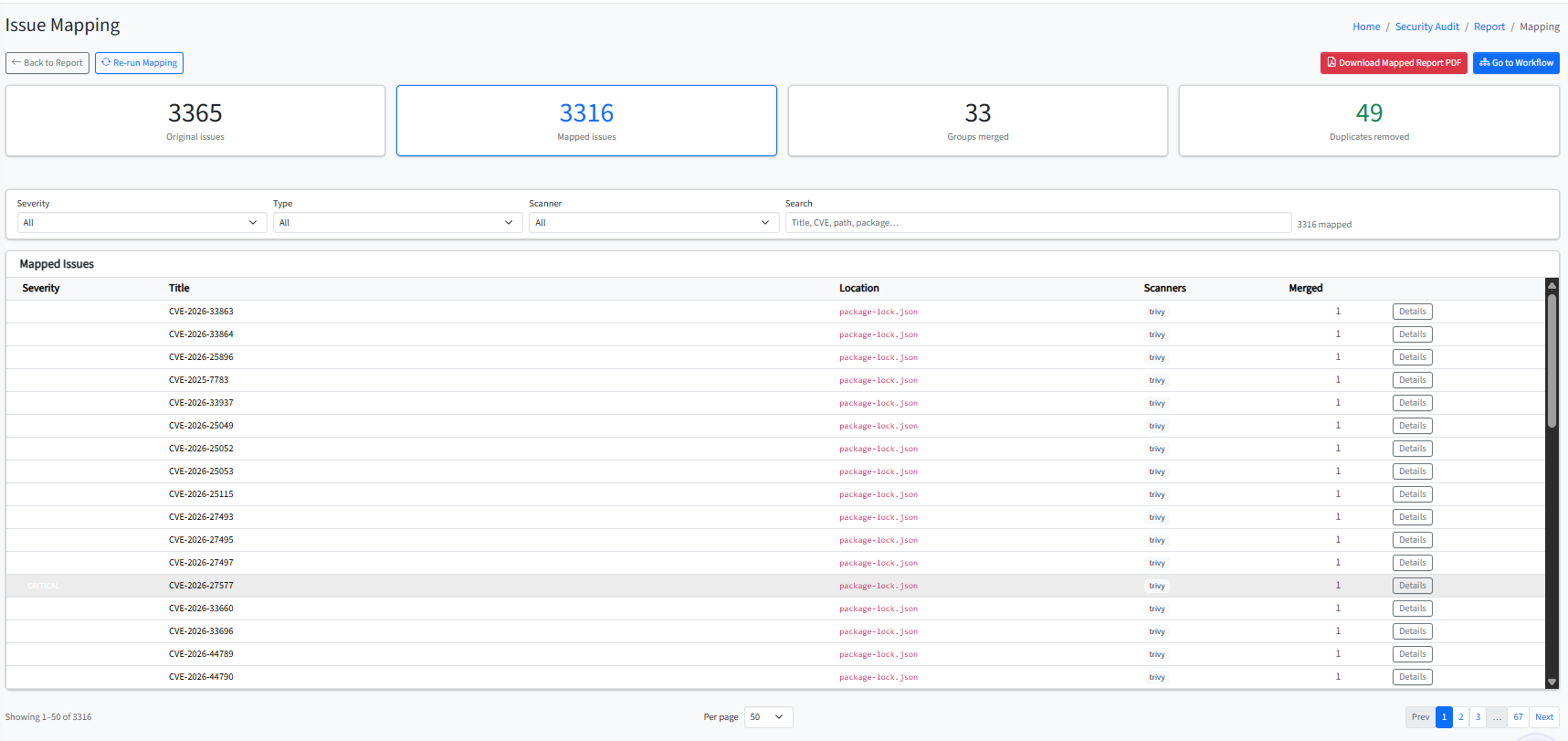
Security teams run many detection technologies. Each produces its own alerts. The same SQL injection may appear four times — from static analysis, dynamic testing, and multiple rule engines — creating alert fatigue and wasted effort.
SSIT correlates findings from every integrated source into one verified issue catalog. One vulnerability. One priority. One remediation path.
- Reduced alert fatigue — fix once, close once
- Faster triage — security teams focus on unique risk
- Better prioritization — severity reflects true exposure, not duplicate counts
- Improved remediation efficiency — developers receive clear, deduplicated guidance
Real Security Outcomes
What organizations achieve with SSIT — beyond running scans
Reduced Duplicate Findings
Cross-scanner correlation eliminates redundant alerts so teams address unique risk.
Faster Remediation
Prioritized catalog, AI guidance, and workflow automation shorten time-to-fix.
Centralized Reporting
One score, one report, one export pipeline for every stakeholder.
Simplified Compliance Prep
SBOM, audit PDFs, and evidence packages ready for auditors and regulators.
Improved Security Visibility
16-category scoring gives executives and boards a clear posture metric.
Reduced Tool Sprawl
One unified platform replaces the cost and complexity of managing many point tools.
Why Security Teams Choose SSIT
The operational difference of a unified security platform
- Multiple disconnected security tools
- Multiple conflicting reports per assessment
- Duplicate findings across scanners
- Manual export and report assembly
- Alert fatigue and slow triage
- Remediation blocked by unclear priorities
- One unified security platform
- One security score across 16 categories
- One deduplicated issue catalog
- One workflow automation engine (AK-Bakery)
- One reporting system for every audience
- Automated remediation workflows and AI guidance
How SSIT Works
From source code to actionable intelligence
GitHub Repo / Source Code
Shallow clone, stack detection, authorized live URLs and cloud credentials
SSIT Orchestrator
Tiered execution with pause, resume, and per-tool status
Integrated Detection
Orchestrated security technologies across code, cloud, and runtime
Finding Correlation Engine
Deduplication into a canonical mapped catalog
Risk Scoring Engine
0–100 score and 16-category prioritization
AK-Bakery Automation
Visual workflows for alerts, exports, and integrations
Reports & Remediation
PDF exports, AI guidance, SBOM, and DefectDojo JSON
Why SSIT Is Different
Not a scanner aggregator — a Security Audit Operating System
Finding Correlation
Maps duplicate alerts into one verified issue — not a raw feed from each tool.
Security Scoring
16-category 0–100 score executives and auditors understand immediately.
AI Remediation
Per-issue guidance explaining impact, exploit paths, and stack-specific fixes.
AK-Bakery Automation
Visual workflows — no scripting — for tickets, webhooks, and exports.
Public GitHub Audit
Prove value in minutes with a free tier — no enterprise sales cycle required.
Enterprise On-Prem Deployment
Licensed Docker inside your network; source code never leaves your boundary.
Mapped Audit Reports
Deliverables built from deduplicated catalogs, not noisy raw scanner output.
Unified Finding Catalog
One prioritized backlog for developers, security, and leadership.
Enterprise Security & Trust
Built for government, healthcare, banking, and regulated industries
- Air-gapped deployment for environments with no external connectivity
- Licensed on-premises Docker — full platform inside your network
- Internal-only source code processing — data ownership stays with you
- Local scanner execution — assessments run within your security boundary
- Persistent audit trails — reports, issues, AI logs, and settings in MongoDB
- Enterprise compliance readiness — SBOM, license compliance, and audit PDF evidence
SSIT meets the deployment and data-sovereignty requirements of organizations that cannot send source code to third-party SaaS platforms.
The Future of Security Auditing
Beyond scanning — toward security intelligence
SSIT is evolving beyond point-in-time scanning into continuous security intelligence.
The platform combines risk prioritization, correlated findings, AI-assisted remediation, and workflow-driven security operations — so teams spend less time managing tools and more time reducing risk.
- Risk prioritization over raw finding counts
- Correlated findings as the system of record
- AI-assisted remediation at the point of triage
- Workflow-driven SecOps via AK-Bakery
- Enterprise security intelligence for boards and regulators
SSIT is a Security Audit Operating System — not a security scanner platform.
One Platform. One Security Score. One Remediation Workflow.
Unified security assessments for modern software teams
Organizations no longer need to choose between depth and simplicity. SSIT replaces disconnected dashboards with a unified assessment lifecycle — from first scan to executive report and automated follow-through.
Whether you are a startup evaluating a GitHub repository, an agency delivering client audits, or an enterprise securing regulated workloads, SSIT delivers correlated intelligence, prioritized risk, and actionable remediation in one place.
Technical Deep Dive
For security engineers, architects, and technical evaluators
What We Check
Unified detection across code, cloud, containers, and runtime — one correlated security platform.
Platform & Domain Detail
Orchestrator behavior, admin UI workflows, and deliverables for each capability
SSIT runs Semgrep and CodeQL against cloned repositories, surfaces injection and auth flaws with file/line precision, and folds SAST into your unified score and mapped catalog.
- Static Application Security Testing (SAST)
- Source code analysis
- Injection vulnerability detection
- Authentication and authorization weaknesses
- Security anti-pattern detection
- Orchestrator shallow-clones the repo, detects languages (Node, Python, Go, Java, PHP, etc.), and selects applicable SAST rulesets.
- Semgrep runs on the public tier; CodeQL runs on enterprise admin when enabled.
- Findings include severity, CWE, code snippet, and scanner rule ID for audit evidence.
- Cross-scanner mapping merges duplicate SAST hits with DAST or SCA findings on the same vulnerability.
- Toggle Semgrep and CodeQL independently in Scan Target scanner options.
- Report issue list filters by severity, category, and scanner source.
- Issue detail page: full description, affected file path, highlighted snippet, and AI remediation panel.
- Export full or mapped audit PDF with SAST findings severity-ordered.
- SAST findings in Full Audit PDF
- Mapped issue catalog
- Per-issue AI fix report
- DefectDojo JSON import
SSIT orchestrates SCA and supply-chain intelligence so CVEs, malicious packages, and transitive risks appear once in your prioritized catalog — not in five separate tool dashboards.
- Known CVEs
- Malicious packages
- Supply-chain risks
- Vulnerable transitive dependencies
- Outdated components
- SBOM cross-check via Syft and OSV-Scanner
- Trivy and npm audit run on every applicable repo; Snyk and Socket activate when API keys are configured.
- OSV-Scanner cross-references lockfiles and SBOM components against the OSV database.
- Orchestrator deduplicates the same CVE reported by multiple SCA tools into one mapped issue.
- Severity reflects CVSS, exploitability, and reachability where scanners provide it.
- Dependency findings grouped under Vulnerabilities & SCA category in the score chart.
- Issue detail shows package name, version, fixed version, and all scanner sources.
- Configure Snyk and Socket API keys in admin settings for commercial intelligence.
- Download CycloneDX SBOM from report actions for supply-chain transparency.
- SBOM CycloneDX
- SCA section in audit PDF
- DefectDojo JSON
- AI remediation for upgrade paths
SSIT scans git history and working tree for leaked credentials, deduplicates across Gitleaks, TruffleHog, and Trivy secret rules, and flags critical findings for immediate rotation.
- API keys
- Access tokens
- Database credentials
- Cloud secrets
- Private certificates
- Gitleaks runs on public and enterprise tiers; TruffleHog is optional on enterprise admin.
- Trivy secret scanner adds container and filesystem secret detection.
- Mapping merges identical secrets found by multiple engines into one issue with all line references.
- High-severity secrets impact the Secrets category score disproportionately.
- Secrets appear in dedicated category with red severity badges.
- Issue detail redacts partial secret values while showing file, line, and rule type.
- Filter report by Secrets category for focused remediation sprints.
- AK-Bakery templates can webhook critical secret findings to Slack or ticketing systems.
- Secret findings in audit PDF
- Mapped secret catalog
- Immediate-rotation checklist via AI assistant
Enterprise admin runs DAST against authorized live URLs via OWASP ZAP sidecar, Nuclei templates, and Nikto — with partial-result recovery if a scan is interrupted.
- SQL Injection
- Cross-Site Scripting
- Authentication weaknesses
- Misconfigurations
- Information disclosure
- API vulnerabilities
- Provide a live website URL in Scan Target; DAST tier runs after repo scanners complete.
- ZAP runs in Docker sidecar with spider and active scan phases; partial results persist on timeout.
- Nuclei executes community and custom templates for known CVEs and misconfigs.
- Nikto adds legacy web server checks; DAST findings map to SAST issues when the same vuln is confirmed statically and dynamically.
- Enable ZAP, Nuclei, and Nikto toggles in scanner options for admin scans.
- Orchestrator shows DAST tier status separately from repo tiers.
- Issue detail links DAST evidence (URL, parameter, request) alongside code findings.
- Public tier does not run full DAST — enterprise required for live URL testing.
- DAST findings in Full Audit PDF
- Mapped cross-scanner confirmation
- Executive summary of live exposure
SSIT generates CycloneDX SBOMs via Syft and cross-checks every component against OSV-Scanner so compliance teams receive machine-readable inventory plus vulnerability correlation.
- CycloneDX SBOM export
- Component inventory across languages
- OSV database cross-check
- Transitive dependency visibility
- Audit-ready artifact for compliance
- Syft runs during the Repo tier on every scan with lockfiles or package manifests.
- SBOM includes name, version, type, and purl for each component.
- OSV-Scanner consumes the SBOM or lockfiles to flag known vulnerabilities per component.
- SBOM download is available from report export actions independent of PDF generation.
- Download SBOM (CycloneDX JSON) from report header export menu.
- SBOM-related findings appear under SBOM and SCA categories in the score chart.
- Issue detail references the affected SBOM component and upgrade path.
- CycloneDX SBOM file
- SBOM-linked findings in audit PDF
- Compliance evidence package
SSIT scans infrastructure-as-code in your repository with Terrascan, Checkov, Kubescape, and Trivy IaC — surfacing misconfigs that become production incidents if unaddressed.
- Terraform and CloudFormation policies
- Dockerfile and compose misconfigs
- Kubernetes manifest compliance
- CIS and NSA framework checks
- Policy-as-code violations
- Stack detection finds Terraform, Dockerfile, docker-compose, and K8s YAML in the repo.
- Terrascan and Kubescape run on public tier when IaC files are detected; Checkov on enterprise admin.
- Findings include resource ID, policy rule, and remediation guidance from the scanner.
- IaC issues contribute to the IaC & Misconfigs score category.
- IaC findings show file path, resource name, and failed policy check.
- Filter by IaC category to review infra team backlog separately from app code.
- Map IaC findings with container or cloud findings when they reference the same resource.
- IaC section in audit PDF
- Policy violation catalog
- Mapped infra + app correlation
Enterprise admin connects cloud credentials so Prowler and Scout Suite audit AWS, Azure, and GCP posture — IAM misconfigs, public buckets, and logging gaps feed your unified score.
- Multi-cloud misconfiguration detection
- IAM and storage exposure
- Network and logging gaps
- Compliance framework mapping
- Continuous posture assessment
- Provide cloud credentials in Scan Target; Infra tier runs Prowler and/or Scout Suite.
- Prowler checks hundreds of CIS-aligned controls per cloud provider.
- Scout Suite delivers multi-cloud visualization and rule-based findings.
- Cloud findings appear in Cloud Posture category separate from IaC repo scans.
- Cloud credential fields in Scan Target with provider selection.
- Orchestrator Infra tier shows Prowler and Scout Suite completion status.
- Issue detail includes cloud resource ARN, region, and remediation CLI where available.
- Cloud posture section in audit PDF
- Compliance mapping evidence
- Executive cloud risk summary
SSIT combines image CVE scanning, CIS benchmarks, and cluster attack-path analysis so container and K8s risk is visible in one report — not scattered across four tools.
- Container image vulnerabilities
- Runtime hardening
- CIS benchmark compliance
- Kubernetes attack paths
- Deployment misconfigurations
- Trivy scans container images referenced in Dockerfiles and compose files.
- kube-bench runs CIS Kubernetes benchmarks when cluster config is provided (enterprise).
- kube-hunter probes for cluster attack paths; Kubescape validates manifests against NSA/CIS frameworks.
- Docker Bench Security checks host-level container hardening on infra targets.
- Container and K8s findings split across Container Security and Kubernetes Security categories.
- Issue detail shows image digest, CVE list, or benchmark control ID.
- Toggle kube-bench, kube-hunter, and Docker Bench in scanner options.
- Container/K8s sections in audit PDF
- CIS benchmark evidence
- Image vulnerability catalog
When you provide a live API URL and OpenAPI spec, Schemathesis property-based fuzzing validates schema compliance and finds auth and input flaws automated scanners miss.
- OpenAPI implementation validation
- Schema compliance
- Authentication weaknesses
- Input validation flaws
- Unexpected behavior detection
- Live URL tier runs Schemathesis against the OpenAPI document in the repo or supplied URL.
- Fuzzing generates edge-case inputs from schema definitions.
- Failures include HTTP status, response body snippet, and operation ID.
- API findings map to DAST and SAST issues when the same endpoint is affected.
- Provide API base URL and spec path in Scan Target.
- API Security category in score chart tracks OpenAPI fuzz results.
- Issue detail shows endpoint, method, and reproduction steps.
- API findings in audit PDF
- OpenAPI compliance report section
Enterprise admin runs authorized Nmap scans against live targets to discover open ports and services that expand your attack surface.
- Open ports
- Running services
- Network exposure
- Misconfigured infrastructure
- Nmap runs in Live URL tier when a hostname or IP is authorized in Scan Target.
- Service detection identifies running daemons and versions.
- Findings feed Network Scanning category in the 16-category score.
- Enable Nmap in scanner toggles; provide authorized target in live URL field.
- Issue detail lists port, protocol, service name, and version banner.
- Combine with DAST findings for exposed admin panels or debug endpoints.
- Network exposure section in audit PDF
- Port/service inventory
SSIT analyzes live URLs with testssl.sh for TLS weaknesses and securityheaders.com for HTTP header grades — both run automatically when a URL is supplied on public and enterprise tiers.
- TLS configuration and cipher strength
- Certificate validity and chain trust
- HTTP security header grades
- Content-Security-Policy and HSTS gaps
- Browser security protections via securityheaders.com
- testssl.sh checks cipher suites, protocol versions, certificate expiry, and known TLS vulnerabilities.
- securityheaders.com integration grades CSP, HSTS, X-Frame-Options, and related policies.
- TLS and Security Headers contribute to separate score sub-categories under Web Security.
- Public tier includes both when visitor adds a website URL to their GitHub audit.
- Live URL field on Scan Target and public audit form triggers TLS and header analysis.
- Findings show grade, missing headers, and recommended policy values.
- Issue detail links to testssl.sh evidence and header scan results.
- TLS/header findings in audit PDF
- Public preview includes sample web security results
SSIT flags GPL, AGPL, and policy-violating licenses across your dependency tree using license-checker, FOSSA (when configured), and Trivy license policies.
- Copyleft license detection
- Unknown and prohibited licenses
- Dependency license policies
- Multi-ecosystem support (npm, Maven, PyPI, Go)
- Policy violation reporting
- license-checker runs on Node projects during Extended tier.
- FOSSA API integration adds commercial license intelligence when keys are configured.
- Trivy reports license metadata alongside CVE data for container and OS packages.
- Violations appear in License Compliance score category.
- License findings show package, declared license, and policy rule triggered.
- Configure FOSSA API key in admin settings for enhanced coverage.
- Filter report by License Compliance for legal review workflows.
- License section in audit PDF
- Compliance evidence for legal teams
- SBOM with license metadata
Enterprise admin optionally scans artifacts with YARA rules and ClamAV to detect suspicious binaries and embedded malware in repositories and build outputs.
- YARA rule matching
- ClamAV scanning
- Suspicious binary detection
- Embedded payload analysis
- YARA rules run against files matching size and extension heuristics.
- ClamAV provides signature-based malware detection on scanned artifacts.
- Findings are high severity by default and isolated in Malware & Artifacts category.
- Enable YARA and ClamAV in optional scanner toggles on enterprise scans.
- Issue detail shows matched rule, file hash, and file path.
- Recommended action: quarantine, remove, or verify with security team.
- Malware findings in audit PDF
- Incident-ready artifact references
When Falco rule packs are enabled, SSIT evaluates Kubernetes runtime policy bundles to detect anomalous syscalls, privilege escalations, and container escape patterns.
- Falco rule pack evaluation
- Runtime syscall anomalies
- Container escape indicators
- Policy-as-code for K8s runtime
- Enterprise optional scanner
- Falco rules run as optional Admin-tier scanner when policy bundles are configured.
- Rules align with community and custom Falco feeds for K8s threat detection.
- Findings contribute to Runtime Policy score category.
- Toggle Falco in scanner options for enterprise assessments.
- Issue detail shows triggered rule, priority, and Kubernetes context.
- Combine with kube-hunter and Falco for defense-in-depth cluster coverage.
- Runtime policy section in audit PDF
- K8s threat detection evidence
The 0–100 score and letter grade translate complex multi-scanner output into a metric executives, clients, and auditors understand immediately.
SSIT transforms thousands of raw findings into a clear security score from 0 to 100, calculated across 16 security categories.
Organizations gain immediate insight into overall security posture, critical risk areas, compliance readiness, and maturity trends.
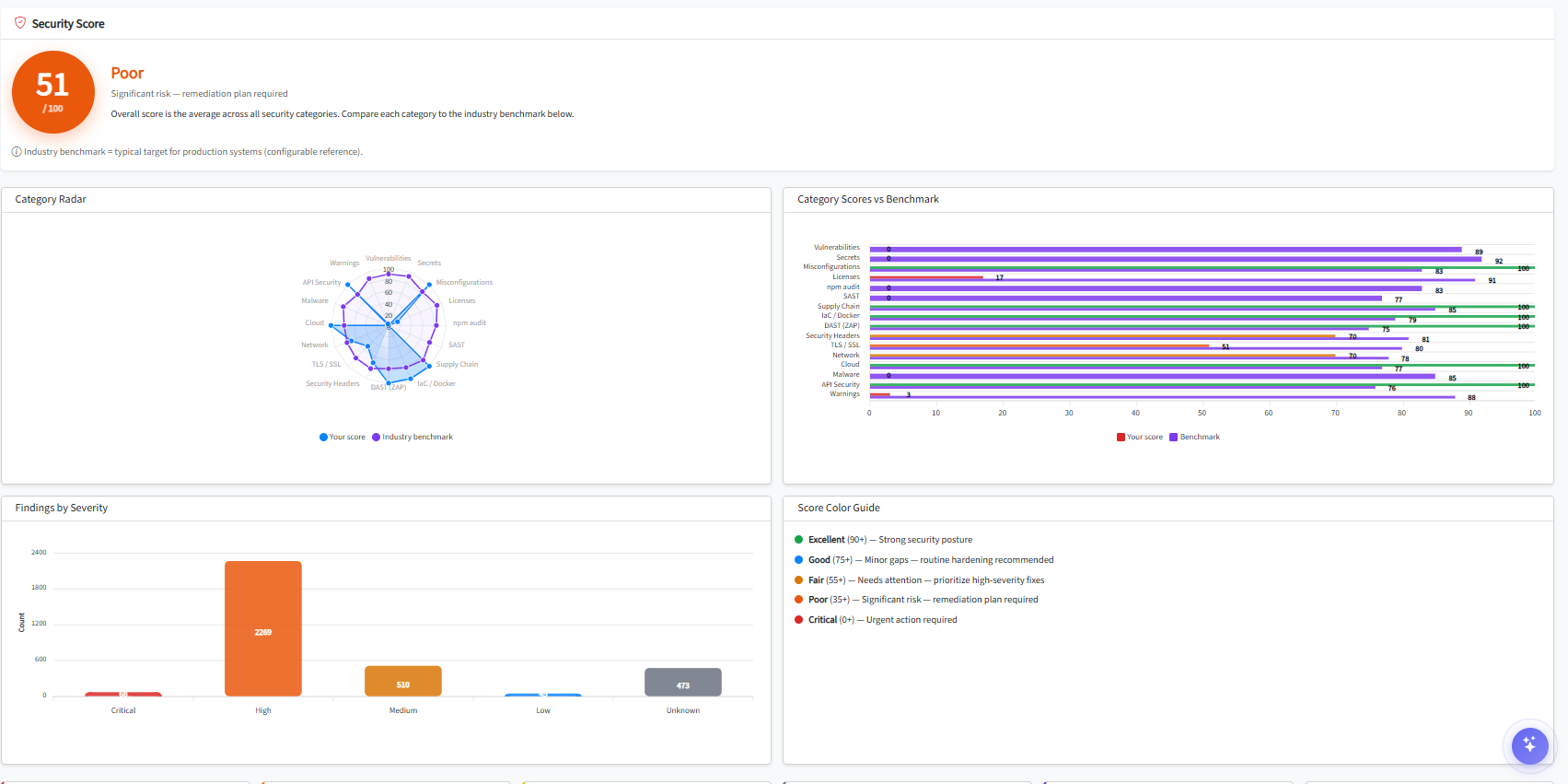
- Sixteen categories each receive a weighted sub-score based on finding severity and count.
- Critical and high findings penalize categories more than informational items.
- Overall score aggregates category scores with configurable weighting.
- Public tier shows score and charts; enterprise shows full finding catalog behind the score.
- Report header displays score, grade, and trend indicators.
- Interactive category charts drill down to findings per domain.
- Public audit layout mirrors enterprise score UX for consistent client experience.
- Score overview in all PDF exports
- Category charts in Full Audit PDF
- Public preview PDF with sample findings per category
AK-Bakery is SSIT's visual automation layer — connect triggers, issues, AI, exports, and webhooks without writing scripts.
- Send alerts and generate reports automatically
- Create tickets and trigger webhooks
- Export findings and sync with security platforms
- Generate AI remediation plans from visual workflows
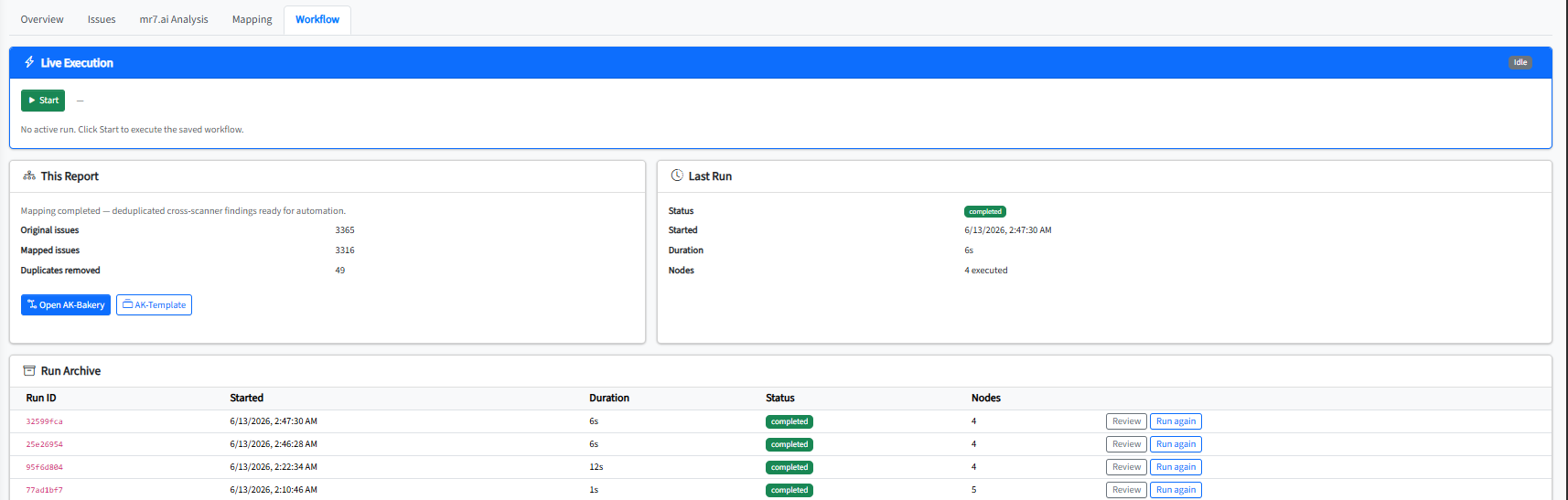
- Built-in templates: CVE Alert, DefectDojo Sync, AI Brief, Ticket Creator, Single Issue Fix Report.
- Node palette: triggers, Get Issue, Issue AI, Export, Webhook, Condition, and more.
- Run controls: execute, pause, view logs, and auto-download exports.
- Workflows operate on mapped issue catalog for accurate automation input.
- Workflow dashboard lists templates and custom workflows with last run status.
- Canvas editor: drag nodes, connect edges, configure parameters per node.
- Execution panel shows step-by-step output and errors.
- Workflow Export CSV/Excel/PDF
- Single Issue Fix Report PDF
- Webhook payloads to Slack/Jira/custom endpoints
AIKit provides per-issue remediation in the admin dashboard — explaining impact, exploit scenarios, and stack-specific fix steps powered by your codebase context.
- What the issue means and why it matters
- How attackers exploit it in practice
- Recommended fixes and secure coding alternatives
- Remediation guidance tailored to your technology stack

- AI analysis runs per issue from issue detail or AK-Bakery Issue AI node.
- Prompts include finding metadata, snippet, and detected stack for relevant guidance.
- AI logs persist in MongoDB for audit trail and re-generation.
- Aggregated AI output exports as AI Recommendations PDF.
- AI assistant panel on every issue detail page — expand for full remediation output.
- Regenerate analysis after code changes or false-positive review.
- AK-Bakery Issue AI node batch-processes top findings in workflows.
- AI Recommendations PDF
- Single Issue Fix Report PDF
- mr7.ai authorized attacker narrative PDF
SSIT generates branded PDFs and structured exports so every stakeholder receives the right level of detail without manual report assembly.
- Executive Security Reports
- Technical Audit Reports
- Compliance Evidence Packages
- SBOM Documentation (CycloneDX)
- DefectDojo Exports
- AI Remediation Reports
- Security Review PDFs
- Full Audit PDF: executive summary, charts, methodology, severity-ordered catalog.
- Mapped Audit PDF: same format from deduplicated catalog post-mapping.
- ZIP Audit splits very large catalogs into summary + findings PDFs.
- Public Preview PDF: score, sample findings, upsell — gated by email on public tier.
- Export menu on report page: Full PDF, Mapped PDF, ZIP, SBOM, DefectDojo JSON, AI PDF.
- Brochure PDF available from landing page for marketing.
- AK-Bakery Export node generates CSV, Excel, or PDF with SSIT branding.
- Full Audit PDF
- Mapped Audit PDF
- ZIP Audit
- Public Preview PDF
- Platform Brochure PDF
- SBOM
- DefectDojo JSON
SSIT scales from free public GitHub audits to licensed Docker on-premises — same orchestrator, same UI, your choice of data boundary.
Public Security Audit
Submit a GitHub repository and receive an immediate security assessment. No account required.
Enterprise Cloud
Full-featured security platform hosted and managed by SSIT with unified detection, mapping, and AK-Bakery.
Licensed On-Premises
Complete data ownership, air-gapped deployment, internal-only source code processing, and unlimited internal assessments.
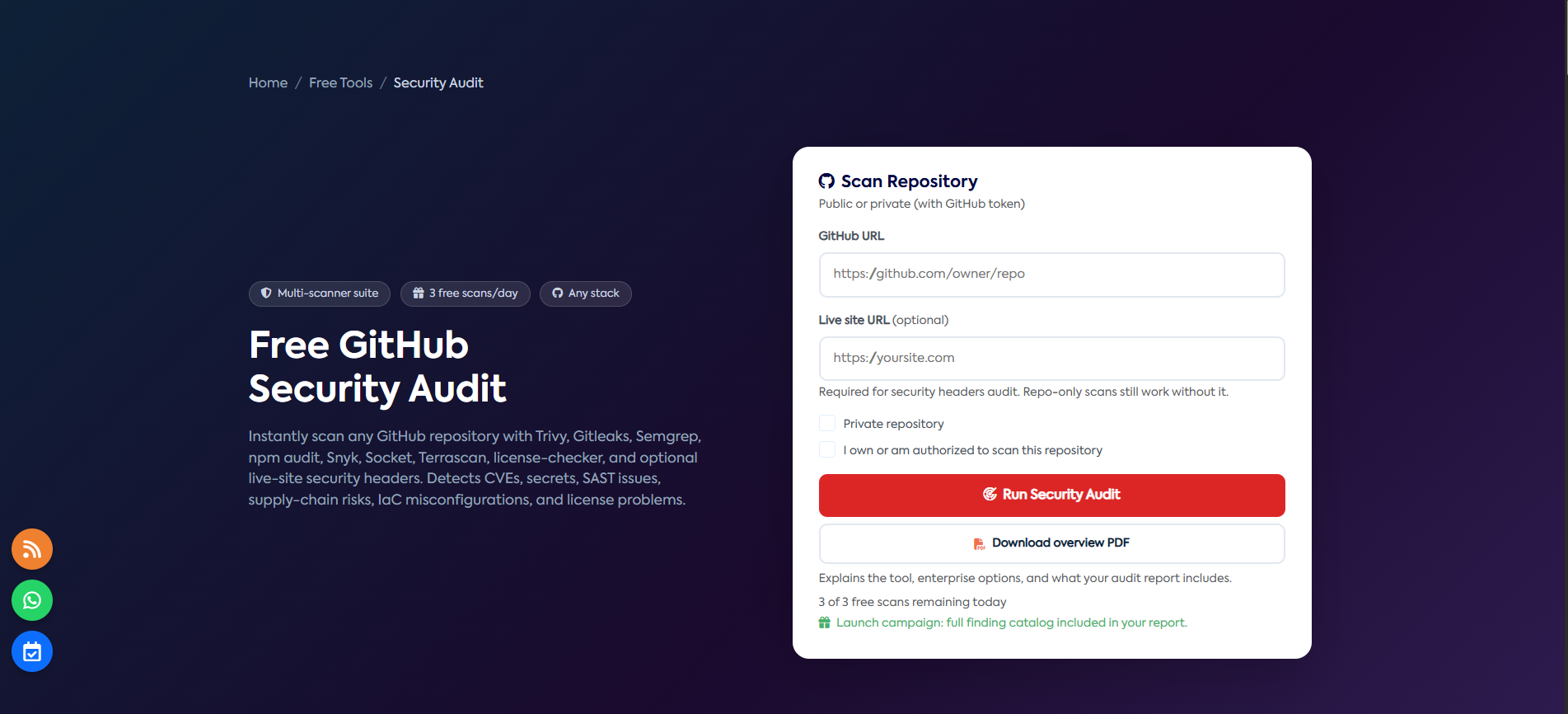
- Public: shallow clone, core detection tier, score + preview PDF, optional live URL for TLS/headers.
- Enterprise cloud: full orchestration, mapping, DAST, cloud, AK-Bakery, and complete exports.
- On-prem: licensed Docker bundle runs entirely inside your network; no source code leaves your boundary.
- Public flow at systemsolveit.com/security-audit — paste GitHub URL, authorize, view score.
- Enterprise admin dashboard: full scan configuration, reports, workflows, settings.
- On-prem install uses same admin UI against local MongoDB and scanner toolchain.
- Public preview PDF
- Enterprise full audit suite
- Air-gapped compliance deployments
Regulated industries need evidence; startups need speed — SSIT delivers both with the same platform.
- Financial and healthcare: on-prem deployment, SBOM, license compliance, audit PDFs for regulators.
- Agencies: white-label reports, client GitHub audits via public tier, full enterprise for engagements.
- SaaS and startups: free tier proves value; enterprise scales to CI/CD integration.
- Branded PDF exports suitable for client delivery and board presentations.
- Industry-specific scanner toggles (e.g., Falco for K8s-heavy healthcare SaaS).
- Consultation scheduling from public preview upsell page.
- Client-ready audit PDFs
- Compliance evidence packages
- SSIT hands-on remediation from $1,000 USD
SSIT replaces a toolchain of disconnected products with one platform — practitioner-built, not resold.
- Unified detection orchestration across every major security domain
- Unified risk scoring across 16 categories
- Cross-scanner correlation and deduplication
- AI-powered remediation per finding
- Workflow automation via AK-Bakery
- Executive and technical PDF exports
- On-premises deployment for regulated environments
- Enterprise scalability from free tier to licensed Docker
All delivered through a single Security Audit Operating System designed for technical depth and operational clarity.
- Breadth: SAST, DAST, SCA, secrets, IaC, containers, cloud, API, network, TLS, SBOM, licenses, malware, runtime — one orchestrated run.
- Clarity: mapping and 16-category scoring replace alert fatigue.
- Action: AK-Bakery and AI remediation turn findings into tickets, fixes, and reports automatically.
- Free public tier removes sales friction — see your score in minutes.
- Enterprise and on-prem scale to regulated workloads without changing workflow.
- Partnership tier: SSIT senior engineers fix what scanners find.
- Complete platform brochure
- Schedule consultation at systemsolveit.com
Scanner Reference — Integrated Detection Technologies
Integrated detection technologies orchestrated in every enterprise assessment. Each tool links to its official project.
 Trivy
SCA / CVE
Free tier
Trivy
SCA / CVE
Free tier
 npm audit
SCA
Free tier
npm audit
SCA
Free tier
 Gitleaks
Secrets
Free tier
Gitleaks
Secrets
Free tier
 Semgrep
SAST
Free tier
Semgrep
SAST
Free tier
 Snyk
SCA
Free tier
Snyk
SCA
Free tier
 Socket
Supply chain
Free tier
Socket
Supply chain
Free tier
 CodeQL
SAST
Enterprise
CodeQL
SAST
Enterprise
 Syft
SBOM
Free tier
Syft
SBOM
Free tier
 OSV-Scanner
SCA
Free tier
OSV-Scanner
SCA
Free tier
 Kubescape
IaC / K8s
Free tier
Kubescape
IaC / K8s
Free tier
 TruffleHog
Secrets
Enterprise
TruffleHog
Secrets
Enterprise
 YARA
Malware
Enterprise
YARA
Malware
Enterprise
 ClamAV
Malware
Enterprise
ClamAV
Malware
Enterprise
 Falco
Policy
Enterprise
Falco
Policy
Enterprise
 Terrascan
IaC
Free tier
license-checker
License
Free tier
Terrascan
IaC
Free tier
license-checker
License
Free tier
 Checkov
IaC
Enterprise
Checkov
IaC
Enterprise
 FOSSA
License
Enterprise
FOSSA
License
Enterprise
 OWASP ZAP
DAST
Enterprise
OWASP ZAP
DAST
Enterprise
 testssl.sh
TLS
Free tier
testssl.sh
TLS
Free tier
 Nuclei
DAST
Enterprise
Nuclei
DAST
Enterprise
 Nikto
DAST
Enterprise
Nikto
DAST
Enterprise
 Nmap
Network
Enterprise
Nmap
Network
Enterprise
 Schemathesis
API
Enterprise
Schemathesis
API
Enterprise
 Docker Bench
Cloud
Enterprise
kube-bench
K8s
Enterprise
kube-hunter
K8s
Enterprise
Docker Bench
Cloud
Enterprise
kube-bench
K8s
Enterprise
kube-hunter
K8s
Enterprise
 Scout Suite
Cloud
Enterprise
Scout Suite
Cloud
Enterprise
 Prowler
Cloud
Enterprise
Prowler
Cloud
Enterprise
Capability Coverage Matrix
Platform capabilities — professional reference
| Capability | SSIT |
|---|---|
| SAST | Supported Semgrep, CodeQL |
| DAST | Supported OWASP ZAP, Nuclei, Nikto |
| SCA / Dependency Scanning | Supported Trivy, Snyk, OSV-Scanner, npm audit |
| Secret Detection | Supported Gitleaks, TruffleHog, Trivy |
| SBOM Generation | Supported Syft, CycloneDX |
| IaC Security | Supported Checkov, Terrascan, Kubescape |
| Container Security | Supported Trivy, Docker Bench |
| Kubernetes Security | Supported kube-bench, kube-hunter, Kubescape |
| Cloud Posture | Supported Prowler, Scout Suite |
| API Security | Supported Schemathesis |
| Malware Analysis | Supported YARA, ClamAV |
| AI Remediation | Supported AIKit per-issue guidance |
| Workflow Automation | Supported AK-Bakery visual workflows |
| Reporting & Exports | Supported Audit PDF, SBOM, DefectDojo JSON |
| On-Premises Deployment | Supported Licensed Docker, air-gapped |
Download the Commercial Overview PDF
Same executive narrative and technical deep dive as this page — formatted for procurement, leadership, and security evaluators. No scan or email required.
Download overview PDFExplore all SSIT services or schedule a meeting for enterprise deployment.
Authorization & Disclaimer
- You must own or be explicitly authorized to scan the repository. Scanning repositories without permission may violate GitHub Terms of Service and applicable law.
- System Solve IT performs security analysis at your request. SSIT is not responsible for any actions, claims, or consequences arising from scans performed without proper authorization or from third-party responses to findings in your repository.
- For abuse prevention, we log your IP address and browser user agent when you initiate a scan. Email is collected only when you download the preview PDF.
- GitHub Personal Access Tokens are used solely for cloning and are never stored on our servers.
Frequently Asked Questions
Is the GitHub security audit really free?
Yes. You get 3 free repository scans per day with no account required. Each preview includes a security score, severity breakdown, up to 10 sample issues per category, and a downloadable preview PDF.
What stacks and repo types are supported?
Any GitHub repository — Express, NestJS, Next.js, WordPress, PHP, Python, Go, Docker, Terraform, Kubernetes configs, and monorepos. No Dockerfile required. Trivy scans the full filesystem; npm audit runs at each package.json root.
Can I scan a private repository?
Yes. Check "Private repository" and provide a GitHub Personal Access Token with repo scope. The token is used only for cloning and is never stored, logged, or included in reports.
What is included in the preview vs the full audit?
The free preview shows full numeric totals by severity and type, up to 10 sample issues per category, stack detection, and a teaser PDF. The $1,000 full audit includes every finding, AI-powered remediation guidance, and hands-on fixes by SSIT engineers.
Do I need to own the repository?
Yes. You must confirm you own or are authorized to scan the repository. System Solve IT performs analysis at your request and is not responsible for unauthorized scans or actions taken by third parties regarding the repository.
How is my scan data used?
We log your IP address and browser user agent for abuse prevention. If you download the PDF, we store your email for follow-up. GitHub tokens are never persisted.
How long does a scan take?
Most repositories complete in 5–15 minutes depending on size and enabled scanners. You are redirected to a dedicated report page immediately — keep that tab open until results appear.
How do I get the full audit and remediation?
Schedule a meeting with SSIT at /schedule-a-meeting. Our DevOps team delivers the complete audit with unrestricted findings and hands-on remediation starting at $1,000 USD.
Preview shows 10 issues per category. Schedule a meeting for the full $1,000 audit + remediation.